

If love alone were enough to connect with your partner and sustain a marriage, most couples wouldn’t struggle to feel close.
Yet many couples who genuinely love each other still feel disconnected, distant, or like they’re living parallel lives.
The reality is that long-term connection doesn’t happen automatically. It requires skills, intention, and regular investment.
Just like learning any meaningful skill — whether in your career, health, or personal growth — learning how to connect with your partner takes practice and the right tools.
In my work as a couples counselor, and through teaching the research of Drs. John and Julie Gottman, I’ve seen this again and again:
When couples learn how to stay emotionally connected, their relationship shifts dramatically — even after years of distance.
There is one simple, research-based practice that has helped more couples reconnect than almost anything else I’ve seen.
And I'll share with you here.
Table of Contents
Why Couples Stop Feeling Connected
Many couples come into relationship counseling sessions saying the same thing:
“We don’t fight all the time, but we just don’t feel close anymore.”
This loss of connection is especially common after major life transitions: children, career pressure, financial stress, or years of prioritizing everything except the relationship.
That was the case for Sandra and David.
After ten years of marriage and three children, they felt like strangers.
David worked long hours.
Sandra stayed home with the kids and felt depleted by the end of the day.
Neither felt understood, seen, or emotionally close.
They didn’t lack love — they lacked connection.
Not sure how disconnected your relationship really is?
Many couples sense something is off long before they can put words to it.
This short relationship check-in helps you understand:
- Where connection has started to slip.
- What kind of repair would actually help.
- Whether this is a phase — or a deeper pattern.
Take the Relationship Check-In
(Takes about 2 minutes)
The #1 Way to Connect With Your Partner: Build Your Love Maps
In our first session of the Repair Program, I introduced Sandra and David to a Gottman Method tool called Building Love Maps.
It’s simple, but incredibly powerful.
A Love Map is the internal map you hold of your partner’s inner world — their hopes, fears, stresses, dreams, preferences, and daily experiences.
Think of it like a GPS for your relationship.
If you’ve ever used Google Maps, you know how frustrating it is when the map is outdated. Roads change. Detours appear. What worked years ago no longer applies.
Relationships are no different.
To truly connect with your partner, your understanding of them needs to stay current.
When insight isn’t enough on its own
Many couples understand what’s happening — but still feel stuck repeating the same cycle.
A complimentary couples consultation gives you a structured, neutral space to explore what’s really driving the distance and whether it’s something that can be repaired.
👉 Schedule a Complimentary Couples Counseling Consultation
(Private • Practical • No pressure)
Why Love Maps Matter So Much
Research from the Gottman Institute shows that couples with well-developed Love Maps:
- Feel more emotionally connected.
- Handle conflict more constructively.
- Recover from arguments more quickly.
- Maintain intimacy and friendship over time.
In other words, the stronger your Love Map, the easier it becomes to stay connected — even when life gets stressful.
Related Article: 45 Relationship Check-in Questions
How to Build & Update Your Love Map

Building a Love Map doesn’t require a long retreat or hours of deep conversation. It starts with curiosity.
Building a Love Map isn’t about interrogating your partner or forcing deep conversations when neither of you has the energy.
It’s about consistent curiosity and creating a habit of staying emotionally informed about each other’s lives.
Think of it as learning how to pay attention again — in a way that feels natural, not forced.
Here’s a simple way to begin:
Step 1: Choose the Right Moment
This matters more than most couples realize.
Pick a time when:
- You’re not already in conflict.
- Neither of you is exhausted or rushing.
- The goal is connection, not problem-solving.
Good moments include:
- During a walk
- After the kids are in bed
- Over coffee
- On a low-pressure date night
Step 2: Start With What You Already Know
Before asking new questions, ground yourself in what you think you know about your partner right now.
On your own, write down:
- Their current stressors
- What seems to energize or drain them lately
- Their daily routines
- Who or what they’re emotionally invested in right now
This step helps you notice where your map is clear — and where it might be outdated.
Step 3: Identify the Gaps in Your Map
Next, write down what you’re not sure about anymore.
For example:
- What are they most worried about right now?
- What do they feel proud of lately?
- What’s been feeling heavy for them?
- What do they wish they had more time for?
These gaps are not failures — they’re invitations for connection.
Want the easiest way to build your Love Map?
If this feels helpful but also like something you might not actually follow through on, you’re not alone.
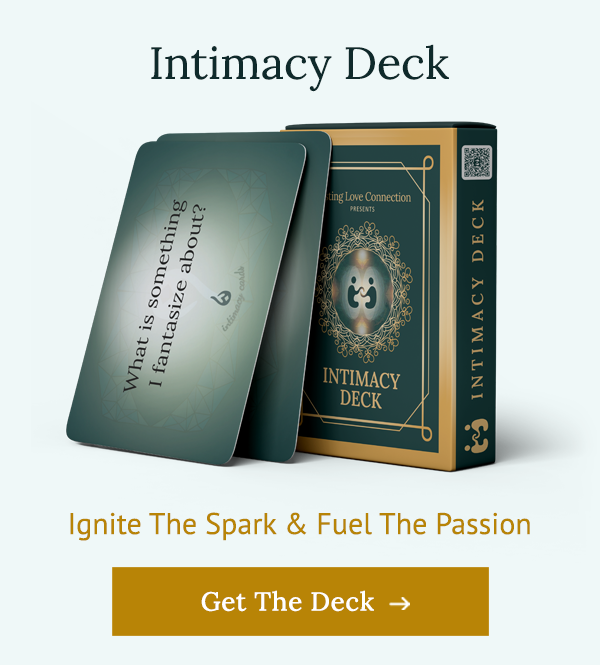
That’s exactly why we created the Intimacy Game.
It’s the simplest way to build — and update — your Love Map without preparation, planning, or emotional strain.
✔ Questions are already written for you.
✔ You can play in just 5 minutes at a time.
✔ No “right way” to do it.
✔ No pressure to go deep unless you want to.
You just pick a card, ask the question, and listen.
👉 Get the Intimacy Game
(An easy, low-pressure way to reconnect with your partner)
Step 4: Ask Open-Ended Questions (Without Fixing)
When you sit down together, take turns asking questions — slowly.
Some guidelines:
- Ask one question at a time.
- Listen to understand, not to respond.
- Don’t correct their experience.
- Resist the urge to fix or reassure.
Examples of Love Map questions:
- “What’s been weighing on you lately?”
- “What feels most stressful right now?”
- “What’s something you’ve been needing more of?”
- “What’s one thing you wish I understood better?”
The goal isn’t problem-solving.
The goal is understanding their inner world.
Step 5: Reflect Back What You Heard
After your partner answers, pause and reflect on what you heard in your own words.
For example:
“It sounds like you’ve been feeling overwhelmed and a bit alone with that.”
This step helps your partner feel seen — and it strengthens emotional safety.
You don’t need to get it perfect. You just need to show that you’re trying to understand.
Step 6: Switch Roles
Now switch.
Let your partner ask you the same types of questions, and practice answering honestly — without minimizing or protecting them from your experience.
Love Maps grow fastest when both partners feel known, not when only one person is doing the emotional work.
This process alone often helps couples feel more connected almost immediately.
Step 7: Make It Ongoing (Not a One-Time Talk)
Love Maps aren’t built once. They’re maintained.
People change. Stressors shift. Needs evolve.
Even checking in for 10–15 minutes once a week can make a noticeable difference over time.
Simple follow-up habits:
- Ask one Love Map question during the week.
- Share one stressor and one highlight each day.
- Stay curious when something feels different.
Connection isn’t sustained by intensity — it’s sustained by attention.
Step 8: Expect Discomfort — and Keep Going
At first, this process can feel awkward or unfamiliar, especially if emotional conversations haven’t felt safe in the past.
That’s normal.
Discomfort doesn’t mean you’re doing it wrong.
It often means you’re touching something that matters.
With practice, curiosity becomes easier — and connection follows.
Not sure where to start?
Building a Love Map doesn’t have to be complicated.
The Intimacy Game turns connection into something you can do in minutes — not hours.
Each card includes a thoughtfully written question designed to help you learn about your partner’s inner world without overthinking or forcing a “big talk.”
👉 Explore the Intimacy Game
(Simple questions. Real connection. Five minutes at a time.)
How Love Maps Led To Connection

As Sandra and David rebuilt their Love Maps, something shifted.
They didn’t suddenly “fix” everything — but they started to feel like teammates again.
Small irritations didn’t escalate as quickly.
Conversations felt less tense.
They began addressing bigger issues from a place of understanding rather than distance.
The key wasn’t finding perfect solutions.
It was learning how to reconnect emotionally — over and over again.
Ready to reconnect with your partner — without guessing
If you’re feeling disconnected but don’t want to keep drifting further apart, you don’t have to figure this out alone.
Our work helps couples rebuild emotional connection by slowing down the cycle, strengthening communication, and restoring trust — even after years of distance.
A complimentary couples consultation helps you decide:
Is this something that can improve — and what would it take?
👉 Schedule Your Complimentary Couples Consultation
(Confidential • 30 Minute Call • Research-based)
A Simple Question to Reflect On
If you were to update your Love Map today, what’s one thing you’d be curious to learn about your partner?
Connection doesn’t come from grand gestures.
It grows from attention, curiosity, and choosing to keep learning each other — even after years together.
And if you have questions or something to share about reconnecting with your partner, feel free to share them in the comments — I read every one.
0 Comments