

Marriage goals are unlike any other kind of goals that most of us make.
Marriage goals help couples stay emotionally connected, aligned, and resilient in the face of change.
This guide walks you through setting healthy marriage goals, creating them together, and using them to strengthen your relationship.
This guide is for couples who want more than surface-level advice. It’s for partners who care about their relationship but feel stuck repeating the same patterns.
It’s for couples who want to create marriage goals that actually improve connection — not add more pressure.
And it’s for anyone who wants a stronger, healthier marriage built on understanding instead of guesswork.
Unlike all those all-too-familiar resolutions that focus on doing something for yourself, your marriage goals should strengthen and enhance your relationship.
While most goals focus on one person, goals in marriage should be about both people and improving the relationship.
Marriage goals give couples a shared direction, especially when communication, intimacy, or trust feels strained.
Table of Contents
Goals For A Marriage That Keep You Together
When you create relationship goals that you and your partner agree to and feel good about, you’ll be divorce-proofing your marriage while increasing the shared bond.
The key here is that your marriage goals are agreeable to both partners.
Scientific research out of the University of Washington and the Gottman Institute on marital success found that shared dreams are a key to a happy marriage. This data makes creating marriage goals all the more powerful for your relationship.
As you can see in the image of the sound relationship house, a healthy relationship dynamic is built on friendship, healthy conflict management, and shared dreams.
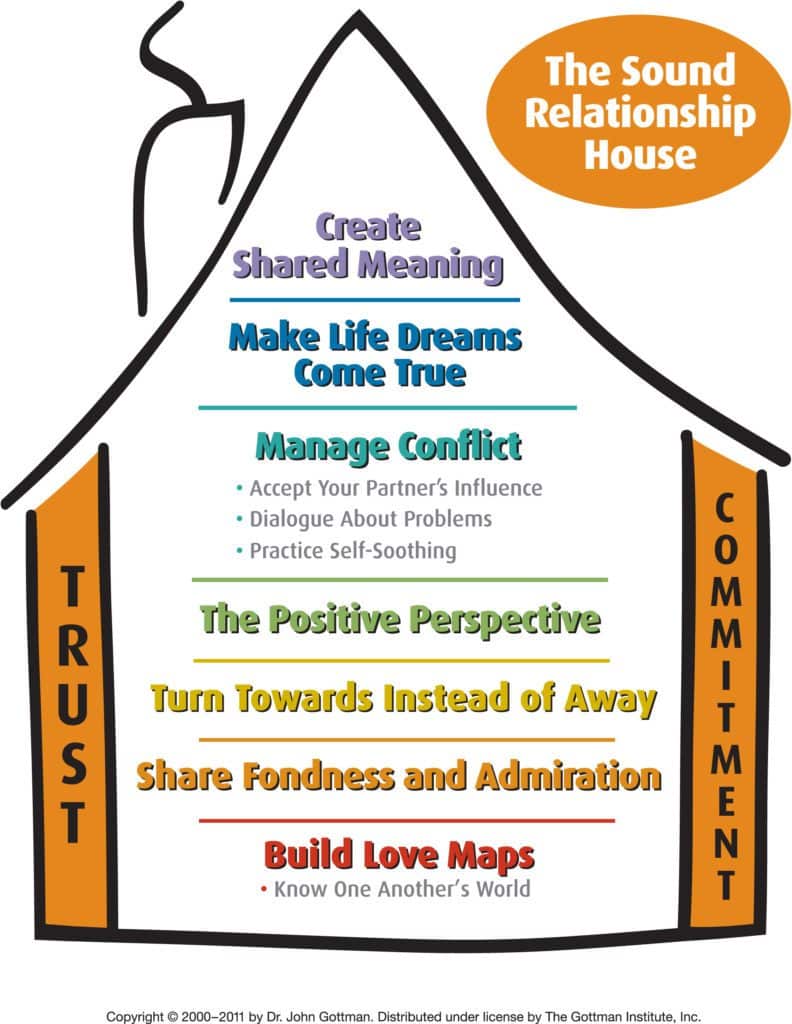
Let's use this image as guidance to help you create a shared dream with your partner. Further, to help you generate marriage goals that work to strengthen your marriage holistically.
As you'll find, creating a stronger friendship, sharing fondness and admiration, and building a shared meaning can happen when you properly set goals in marriage. For this reason, in this article, we'll also look at how to build a vision as a couple for your relationship.
Below you’ll find 21 Marriage Goal ideas, and below that, you’ll learn how to create marriage goals with your partner.
Take note that engaged couples can also benefit from discussing marriage goals and asking each other important questions before getting married.
Get a research-based assessment session that helps you understand what’s supporting your marriage goals — and what may be quietly undermining them.
→ Relationship Assessment Session
21 Marriage Goals Every Couple Can Use to Build a Strong Relationship
These goals in marriage aren’t about perfection—they’re about creating a healthy, intentional marriage that can grow. This list provides 21 marriage goals examples you can reference when creating your own.
- Create open and honest communication and check in on your relationship regularly
- Get on the same page with finances
- Create a shared financial vision for the future
- Openly appreciate each other more often
- Listen to each other so we both feel valued and heard
- Create a savings account for our dream to buy a house, a new car (or whatever else)
- Have regular date nights and special evenings together as a couple
- See each other’s families more often
- Have sex more often (and address any challenges with sexual desire)
- Spend more time with other couples
- Take up new hobbies and interests as a couple
- Create a vision for our retirement and start working towards that future
- Explore our sexuality together
- Create more and deeper intimacy
- Go to counseling as a couple
- Open up a shared banking account and create shared savings
- Get a pet
- Create a plan to have a child (or adopt)
- Take a trip abroad, or somewhere we’ve never been to before
- Take a class together (like dance, art, or something new)
- Find new ways to inject more fun and romance into the marriage
What Are Marriage Goals (And Why They Matter for Long-Term Relationships)
Healthy marriage goals support emotional connection, shared meaning, and the ability to navigate conflict without damaging the relationship.
Goals for a strong marriage help couples stay connected during stress instead of drifting apart silently.
The list of marriage goals can be endless. We designed these 21 goal ideas to help get your juices flowing.
Every couple will have their ideas of what they'd like to accomplish - it's not so much the goals that matter - it's how you design and create them that matters.
With marriage goals, the most important part is creating unification, discussion, and more togetherness. Once you’re more together, you’ll find making and achieving your objectives will be simple.
To help you create healthy marriage goals that support your marriage, let’s look at the right way to create goals in marriage.
Video - Relationship Goals And How To Create Them In Your Marriage
If you prefer learning visually, the video below walks through how couples can create meaningful goals in marriage together—and avoid common mistakes that keep goals from sticking.
Resources From The Video:
Intimacy Deck Game and Access the Save Your Marriage Workbook.
How To Create Marriage Goals With Your Partner
Creating clear marriage goals helps couples move from reacting to problems to building a relationship on purpose. Here are the steps to creating marriage goals.
Step One: Schedule Time To Create Marriage Goals
The first step in creating goals for a marriage will be to spend some time talking. The only way that happens is if you schedule a time to be together.
To create that vision and future together as a couple, begin by setting time aside with your partner.
My advice is to schedule a date and let your partner know that you’d be excited to talk about dreams, hopes, and aspirations during your time together.
Having the agreement to go out and share dreams can be fun and exciting, and will make the anticipation of your date more intriguing.
When we schedule time together, we’re one step closer to creating a vision for our relationship and future.
As someone once said:
“What gets scheduled gets done.”
If you’re reading this now, take a pause. Text, email, or call your partner into the room and say this:
“Hey. I’d like to know more about your dreams, aspirations, and hopes. Can we schedule a time to go out and do that? When would work for you?”
Before you read any further, send that text or email off.
By letting your partner know you’d like to schedule time together, you are communicating that you want to see your spouse and get closer, and you’re sharing your love through an action that says:
“I like you. I’d like to see you. So let’s schedule some time to be together. You are important to me.”
Send that text, email, or verbally ask your partner when you two can have time together.
Once you have that date set, it’ll be easy to execute the rest of the steps below.
Step 2: Ask Questions, Be Curious, Build Love Maps

Creating goals for a marriage should be fun, exciting, and an opportunity to explore.
With curiosity and questions, you can use this moment as a way to get to know your partner, dig into learning about her, and create deeper intimacy.
One of the keys to a successful marriage is creating ‘Love Maps.’ If you're curious, a love map is created by asking questions and inquiring about your partner. The stronger your insights and knowledge are about your partner, the better you can navigate problem resolution and anything else.
If you want to make a helpful love map (which you should), you must ask questions and get curious.
For a great game to play to help in this process of making love maps, check out the Intimacy Deck. This game makes asking new and exciting questions simple and shows you how much you already know.
Bring the Intimacy Cards to your date nights, and surprise your partner with a fun, scientifically proven game that helps couples get closer.
If you know that you’d like to make specific goals in marriage with your partner, consider the questions you’d like to ask your partner. The goal shouldn’t be to get your way. Instead, the objective is to learn about your spouse’s world and get closer.
Step 3: Share Your Dreams Too
Sometimes when working with couples, I find that one partner is reserved.
While one spouse openly shares their dreams and goals with gusto, the other person keeps their hopes locked inside.
When one person shares and the other doesn’t, it’s hard for both people to have their desires met.
In this process, it’s essential you share your dreams and hopes. You can be curious, ask questions, and build love maps, and in turn, it helps if your partner does the same for you.
Marriage goals in action
In one online marriage counseling session, I recall this wonderful couple. They had two beautiful kids, had been together for a decade, and they came to me to improve their communication.
During one of our sessions, we discussed the role of curiosity, love maps, and the power of asking questions to deepen intimacy.
With gusto, they dove into using the Intimacy Game.
When the wife asked her husband about his dream job, he said:
“The work I do is great. It feeds you and the kids.”
Watching him, I could feel that he was holding back. So, with encouragement, I inquired:
“Steve, your dream job is to own a construction company? Or did you fall into that, and now it feeds the family?”
With some thought, he hesitated and then softly responded:
“Well, you know. I used to dream of being a truck driver. Of course, I know I can’t ever do that. I’d never want to leave my wife and my kids for days. But if I could do anything, I would drive a truck.”
Like a flash, his wife lit up. *I know it may not sound like much, but that new piece of information is fodder for more conversation, intimacy, and getting to know someone.
Curious, his wife asked him more questions.
“Why would you want to drive a truck? I didn’t know you liked driving so much. What about driving a truck do you like?”
From there, he revealed how much he wanted to travel across the United States, that he liked being out on the road, and that even as a child, he loved big semi-trucks.
As you can imagine, this tiny revelation led to new marriage goals. With that new data, they began to discuss a road trip, looking at big semi-trucks as a date and things they could do to help him enjoy his dream. Just one new piece of information can help couples bond and feel closer (even after decades of being married).
Just like that couple discovered - in marriage goals, there is a space for your dreams and your partner’s goals, and there’s a place where all those visions merge to help make your marriage more amazing.
→ Communication Program: For couples who want to reduce conflict, feel heard, and talk about goals without conversations turning tense or defensive.
Step 4: Take Small Steps Toward Your Dreams
Now that you’ve discussed your dreams, goals, and visions as a couple, it’s time to take action.
In the same way, this blog grows word by word, day by day, your goals in marriage grow with small actions that make things happen.
When you and your partner decide you’d like to buy a house, you likely won’t be able to plunk down a few hundred thousand dollars or more and make that purchase. Instead, it will take many little actions. For example, creating savings, speaking to a real estate agent, looking at homes online, visiting homes you like in person, and having many back-and-forth conversations.
You make significant transformations by taking small daily or weekly actions toward your marriage goals.
Small movements toward your desires are how you create what you want.
No one reaches their destination with one big step; it happens in many tiny movements.
As successful research from Cornell University put it:
“Once a small win has been accomplished, forces are set in motion that favor another small win.”
To achieve your goals, you and your partner will do well to consider:
- What are some small steps we can take together to arrive at our goal?
- Are there steps you’d like me to take to get us there?
- What are some steps you’re committed to making?
- What do we need to be like a focused laser beam?
Think of these questions as another way to build love maps.
Finding your answers and discussing with your partner can be fun and insightful, and help you two become a stronger couple.
Once you’ve taken the time to answer these questions and you’ve done the love maps, you’ll find the actions come more naturally. Being a team will be more comfortable, and your marriage will blossom to new levels because you've created marriage goals thoughtfully.
Creating marriage goals is less about ‘arriving’ somewhere and more about coming together as a team. The more you think of this process as a way to be unified, the more your marriage will prosper.
What marriage goals are — and what they aren’t

Marriage goals for couples work best when they describe how you relate to each other, not just what you hope to achieve together.
Marriage goals aren’t checklists or resolutions.
They’re not about fixing your partner or forcing alignment.
Healthy marriage goals describe how you want your relationship to function, not just what you want to achieve.
Strong marriage goals focus on
- How you communicate under stress
- How you repair after conflict
- How you stay emotionally connected over time
When couples skip this foundation, goals become another source of pressure.
When couples get it right, goals create direction, safety, and shared meaning.
This is why marriage goals for couples work best when they’re grounded in emotional safety and mutual understanding — not willpower.
Healthy marriage goals focus on the relationship, not just outcomes
Healthy marriage goals for couples focus on communication, repair, and emotional safety — not performance or perfection.
Many couples set goals around outcomes.
Buying a house.
Saving more money.
Improving sex.
Parenting better.
Those goals matter.
But relationship goals within a marriage determine whether those outcomes bring you closer or pull you apart.
Healthy goals in a marriage sound like
- “We want to handle conflict without shutting down or escalating.”
- “We want to feel emotionally connected even during busy seasons.”
- “We want to repair disagreements quickly instead of letting resentment build.”
These goals strengthen the relationship, which makes everything else more achievable.
This is the difference between surface goals and goals for a strong marriage.
Why marriage goals fail when couples don’t create them together
One of the biggest reasons marriage goals fail is misalignment.
One partner is thinking about stability. The other is thinking about the connection.
One wants fewer arguments. The other wants deeper conversations.
When goals aren’t created together, couples unknowingly work at cross-purposes.
Marriage goals for couples need to be
- Mutually agreed upon
- Emotionally understood
- Revisited as life changes
Without that, even “good” goals can create distance.
Shared goals don’t come from compromise alone. They come from curiosity, honesty, and understanding how each of you experiences the relationship.
How to create marriage goals that actually stick
If you’re wondering how to create marriage goals that last, start here.
First, clarify what isn’t working. Where does tension show up most often? Where do you feel disconnected, misunderstood, or alone?
Then ask:
- What do we want more of in our relationship?
- What feels missing right now?
- What would feeling “strong” or “healthy” actually look like for us?
Strong marriage goals emerge from understanding patterns — not avoiding problems.
When couples slow down enough to answer these questions honestly, goals stop feeling abstract and start feeling achievable.
→ Date Night Workbook: A guided resource with communication exercises, reflection prompts, and relationship practices to help you create your goals for marriage together.
Marriage goals change as relationships evolve — and that’s healthy
Marriage goals aren’t set once and forgotten. They evolve with seasons of life.
Early relationships focus on building connection. Mid-stage marriages often focus on stress, parenting, or balance. Later stages may focus on intimacy, meaning, or rebuilding after loss.
A healthy marriage allows goals to change without interpreting that change as failure.
Couples who revisit and refine their marriage goals stay more connected because they’re responding to reality — not clinging to outdated expectations.
→ Intimacy Program: For couples looking to rebuild emotional and physical closeness and shared goals.
When marriage goals feel hard to define
Some couples struggle to name marriage goals at all.
Not because they don’t care — but because the relationship feels confusing or stuck.
If conversations about goals turn tense or vague, that’s usually a sign that something deeper needs attention first.
Often, communication patterns or emotional safety need support before goals can be clarified.
This is where guided support can help couples slow things down, understand what’s underneath the surface, and create relationship goals that actually fit.
What are marriage goals?
Marriage goals are shared intentions that guide how a couple communicates, handles conflict, and stays emotionally connected over time. Healthy marriage goals focus on the relationship itself, not just external achievements.
Why are marriage goals important for couples?
Marriage goals help couples stay aligned, especially during stress or life transitions. When couples have shared goals, they’re more likely to communicate clearly, repair conflicts faster, and feel like they’re on the same team.
What are healthy marriage goals?
Healthy marriage goals support emotional safety, connection, and repair. Examples include improving communication, rebuilding trust, staying emotionally connected, and learning how to navigate conflict without escalation or shutdown.
How do you create marriage goals as a couple?
Creating marriage goals starts with understanding what’s not working and what each partner needs. Strong marriage goals are created through honest conversation, curiosity, and shared understanding—not pressure or compromise alone.
What’s the difference between marriage goals and relationship goals?
Marriage goals and relationship goals often overlap. Marriage goals usually focus on long-term partnership, shared responsibilities, and emotional connection, while relationship goals may also apply to dating or earlier stages.
Why do marriage goals fail?
Marriage goals often fail when they’re created by one partner, focused only on outcomes, or not supported by communication and emotional safety. Goals work best when both partners feel heard and invested.
Can marriage goals help a struggling relationship?
Yes. When couples clarify healthy marriage goals and address underlying patterns, goals can help restore direction, reduce conflict, and rebuild emotional closeness—especially when paired with the right support.
Do marriage goals change over time?
Yes. Marriage goals naturally evolve as couples move through different seasons of life. Revisiting goals regularly helps relationships stay flexible, connected, and resilient.
What if we don’t agree on marriage goals?
Disagreement often signals deeper unmet needs or communication patterns. Supportive conversations—or guided help—can help couples understand each other and create shared goals that feel realistic and meaningful.
Should couples get help when setting marriage goals?
Many couples benefit from guidance when creating marriage goals, especially if conversations feel stuck or tense. Support can help clarify priorities, improve communication, and create goals that actually strengthen the relationship.
Goals In Marriage - Deeper Support
Marriage goals work best when they’re supported by communication, emotional safety, and shared understanding.
Without those foundations, even the best intentions can stall or turn into frustration.
If you want support strengthening the skills that make marriage goals achievable, these resources can help:
Next steps if you want to turn insight into action
Reading about marriage goals can create awareness.
Change usually happens when couples slow things down together.
If you want help clarifying your goals, improving communication, or rebuilding connection, a complimentary couples consultation can help you identify the most supportive next step — without pressure or commitment.
A calm, focused conversation to clarify what your relationship needs most and which type of support makes sense right now.
→ Complimentary Couples Consultation
0 Comments